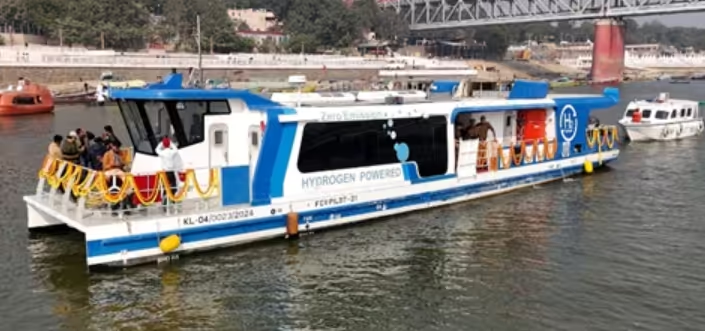
Government of India to promote Inland Water Transport (IWT) under Maritime India Vision 2030 and Maritime Amrit Kaal Vision 2047
The Government of India is pushing hard on Inland Water Transport (IWT) as a pillar of its multimodal transport vision, and the press release you’re viewing outlines a very ambitious roadmap.
Infrastructure & Digital Reforms
- 32 National Waterways operationalized with multimodal terminals, cruise jetties, and community jetties.
- Digital platforms like PANI (navigation info), Jalyan & Navic (vessel/crew registration), CAR‑D (cargo data), and Jal Samriddhi (commercial ops) are streamlining approvals and logistics.
- Electronic Navigational Charts and hydrographic surveys are improving safety and efficiency.
Cost & Environmental Advantage
- Freight cost per ton‑km:
- IWT: ₹1.06
- Rail: ₹1.36
- Road: ₹2.50
- Emissions: IWT matches rail (0.0006 Rs/TKm) and is far cleaner than road (0.0031 Rs/TKm).
- Air pollution costs: IWT (0.03 Rs/TKm) vs. Road (0.202 Rs/TKm).
Policy Measures
- Jalvahak Scheme: 35% incentive for cargo owners/operators on NW‑1, NW‑2, NW‑16.
- Tonnage Tax Extension: predictable tax regime for inland vessels.
- National Waterways Regulations 2025: transparent framework to attract private investment.
- PSU Cargo Shift Mandate: over 140 PSUs directed to allocate cargo to waterways.
- Coastal Shipping Act 2025: modernized regulations, effective March 2026.
- Coastal Cargo Promotion Scheme: aims to double IWT/coastal shipping share from 6% to 12% by 2047.
Regional Projects
- Northeast (NW‑2, NW‑16): ship repair facility at Pandu, tourist jetties, regional excellence centre at Dibrugarh.
- Southern (Kerala, AP, Telangana): fairway development, Ro‑Ro terminals, floating jetties.
- Eastern/Western/Northern states: coal evacuation via NW‑5, cruise tourism in Goa/Karnataka, Sundarbans international route maintained.
- J&K, Himachal, Punjab: new jetties, feasibility studies for Beas & Sutlej rivers.
Financial Progress
- JMVP‑1 (Ganga River): ₹5061 crore, ~82% complete.
- NW‑2 (Brahmaputra): ~100% complete.
- NW‑16 (Barak River): ~49% complete.
- 23 NWs Phase‑1: ~90% progress.
- Total sanctioned: ₹6907 crore across projects.
This modernization drive positions IWT as a low‑cost, green, and scalable alternative to road and rail freight, while also opening up tourism and regional development opportunities.
Follow us on Insta