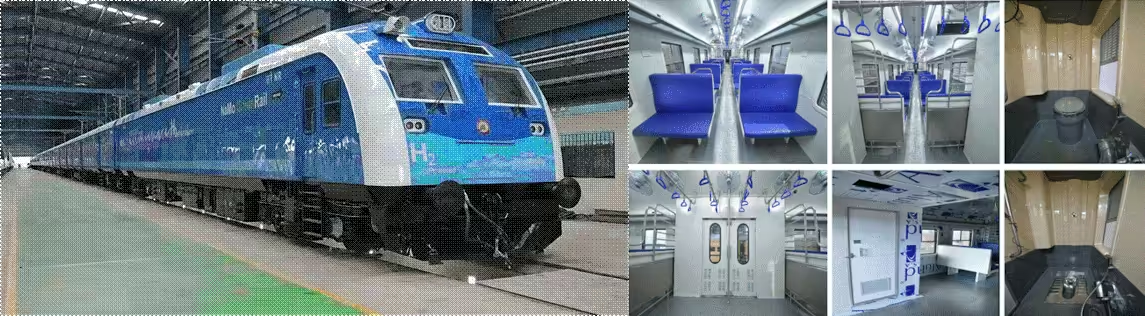
India's First Hydrogen Fuel Cell Train Set to Redefine Sustainable Rail Mobility with Capacity of Around 2,600 Passengers
Indian Railways is about to flag off a groundbreaking innovation: India’s first Hydrogen Fuel Cell Powered Trainset.
Sustainability & Technology
- Generates electricity onboard using hydrogen + oxygen, with water vapour as the only by-product.
- Represents the greenest form of rail propulsion, eliminating combustion and external power dependence.
- Designed for 75 km/h operational speed on the Jind–Sonipat section, with a 110 km/h design speed.
Train Configuration
- 10-coach passenger train with capacity for ~2,600 passengers (much larger than typical 2–3 coach hydrogen trains abroad).
- Two Hydrogen Driving Power Cars (DPCs) at each end, each producing 1,200 kW (1600 hp).
- Equipped with fuel cells, LFP batteries, and hydrogen storage cylinders.
Safety Systems
- Multi-layer safety design: leak detectors, flame detectors, automatic shut-off, ventilation, and loco pilot emergency protections.
- Hydrogen ecosystem designed to NFPA-2 and ISO 19880 standards, approved by PESO.
- Independent safety assessment conducted by TÜV SÜD, Germany.
Refuelling Infrastructure
- India’s largest railway hydrogen refuelling facility at Jind, Haryana.
- Produces hydrogen via electrolysis, compresses to 500 bar, and dispenses at 350 bar.
- Stores ~3,000 kg hydrogen, enough for regular operations.
Indigenous Development
- Designed and integrated in India with RDSO, Medha Servo Drives, and Integral Coach Factory (ICF).
- Establishes a complete hydrogen rail ecosystem: rolling stock + production + storage + dispensing.
Global Context
- Germany pioneered hydrogen trains; France, Italy, China, Japan are testing pilots.
- India’s project is larger in scale and ambition, positioning it as a leader in hydrogen rail technology.
- Future plans include deploying hydrogen trains on heritage routes like Kalka–Shimla.
This initiative ties directly into India’s National Green Hydrogen Mission and long-term Net Zero goals, making railways a showcase of sustainable innovation.
Follow us on Insta