Mission 100% Electrification: Powering the Future of Indian Railways
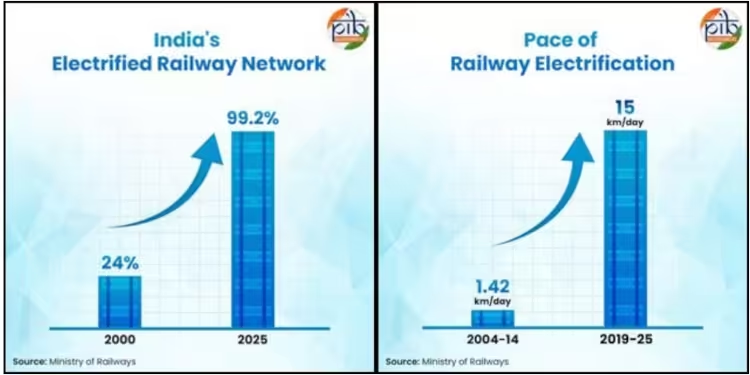
Indian Railways has electrified about 99.2% of its network by November 2025, making it one of the world’s most extensively electrified rail systems. Network Coverage: - By November 2025, Indian Railways electrified 69,427 Route Kilometers (RKMs), covering 99.2% of its 70,001 RKM Broad Gauge network. - Out of this, 46,900 RKMs were electrified between 2014–2025. Acceleration in Pace: - Electrification speed rose from 1.42 km/day (2004–2014) to 15+ km/day (2019–2025). - Electrified track share grew from 24% (2000) → 40% (2017) → 96% (2024). State Status: - 25 States/UTs are fully electrified. - Only 5 states have residual work (574 RKM total): - Rajasthan (93 km), Tamil Nadu (117 km), Karnataka (151 km), Assam (197 km), Goa (16 km). Renewable Energy Integration - Solar Power Growth: - Capacity expanded from 3.68 MW (2014) → 898 MW (2025) (≈244x increase). - Installed at 2,626 stations nationwide. - 629 MW (70%) used for traction (train operations). - 269 MW for non-traction (lighting, workshops, quarters). Modern Technologies - Cylindrical Mechanised Foundations: Faster, less labor-intensive installation for overhead electrification. - Automatic Wiring Train: Simultaneous catenary & contact wire installation with precise tension control. Global Comparison (UIC, June 2025) Country - Electrification (%) Switzerland - 100% India - 99.2% China - 82% Spain - 67% Japan - 64% France - 60% Russia - 52% UK - 39% Strategic Importance - Cleaner Transport: Electric traction is ~70% more economical than diesel. - Energy Security: Reduced dependence on fossil fuels. - Inclusive Growth: Electrification boosts industrial & rural development along corridors. - National Vision: Aligns with India’s Net Zero Carbon Emission goals and sustainable infrastructure aspirations. ✨ In short, Indian Railways is on the threshold of complete electrification, transforming from a diesel-driven giant into one of the world’s greenest, most efficient rail networks.
Follow us on Insta