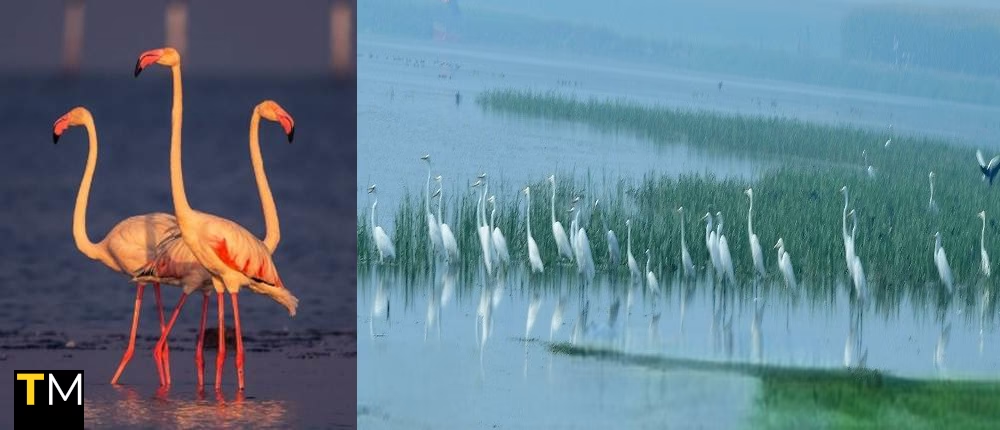
Ramsar Sites in India: Safeguarding Wetlands of International Importance
India has expanded its network of Ramsar Sites from 26 in 2014 to 103 in 2026, covering over 13.87 lakh hectares.
India ranks 1st in Asia and 3rd globally in the number of Ramsar Sites.
Wetlands play a crucial role in biodiversity conservation, flood control, groundwater recharge, and livelihoods.
What is a Ramsar Site?
-
A wetland designated as a Wetland of International Importance under the Ramsar Convention.
-
Recognized for ecological, hydrological, botanical, and zoological significance.
-
The Ramsar Convention was adopted in Ramsar, Iran, in 1971.
India and the Ramsar Convention
-
India became a signatory to the Convention on 1 February 1982.
-
Ramsar Sites are spread across 28 States and Union Territories.
Key Statistics
-
Total Ramsar Sites: 103
-
Area Covered: Over 13.87 lakh hectares
-
Highest Number of Sites: Tamil Nadu (20)
-
Second Highest: Uttar Pradesh (14)
-
Largest Ramsar Site: Sundarban Wetland, West Bengal (4.23 lakh hectares)
Latest Additions (October 2026)
Sukhna Wetland, Chandigarh
-
Human-made reservoir at the foothills of the Shivaliks.
-
Important habitat for migratory birds and threatened species.
Sauj Jheel, Uttar Pradesh
-
Floodplain wetland in Mainpuri district.
-
Hosts over 30,000 waterbirds and supports several threatened bird species.
Milestones
-
100th Ramsar Site: Surha Tal (Uttar Pradesh), June 2026.
-
101st Ramsar Site: Glaw Lake (Arunachal Pradesh), August 2026.
-
102nd & 103rd Sites: Sukhna Wetland and Sauj Jheel, October 2026.
India's First Ramsar Sites
-
Chilika Lake (Odisha)
-
Keoladeo National Park (Rajasthan)
-
Both designated on 1 October 1981.
Benefits of Ramsar Designation
-
International recognition and visibility.
-
Access to scientific guidance and conservation expertise.
-
Encourages international cooperation and funding support.
-
Strengthens wetland management and protection.
Conservation Success Stories
Chilika Lake, Odisha
-
Successful ecological restoration.
-
Supports 118 fish species and large migratory bird populations.
East Kolkata Wetlands
-
Naturally treats Kolkata's wastewater.
-
Produces around 10,500 tonnes of fish annually and supports about 50,000 people.
Sundarban Wetland
-
Protects coastal areas from cyclones and tidal surges.
-
Serves as a critical mangrove ecosystem and fish nursery.
Government Initiatives
Wetlands (Conservation and Management) Rules, 2017
-
Provides the regulatory framework for wetland conservation.
National Plan for Conservation of Aquatic Ecosystems (NPCA)
-
Integrated scheme for scientific wetland and lake management.
Amrit Dharohar
-
Focuses on Ramsar Site conservation, biodiversity documentation, tourism, and carbon assessment.
Mission Sahbhagita
-
Citizen-led wetland conservation initiative.
-
Over 20 lakh volunteers have helped map more than 1.7 lakh wetlands.
MISHTI
-
Mangrove restoration programme across coastal states and UTs.
-
Targets restoration of 540 sq. km of mangroves.
Wetland City Accreditation
-
Indore and Udaipur became India's first Ramsar-accredited Wetland Cities in January 2025.
Way Forward
-
Strengthen scientific monitoring and management.
-
Promote community participation and sustainable livelihoods.
-
Integrate wetland conservation into broader development planning.
-
Enhance climate resilience, biodiversity protection, and water security through long-term conservation efforts.